

If you are in the process of joining with one (or several) of your family therapy clients, then it’s likely you already know that it’s not always easy. Family therapy is hard work for all involved, both for you as the family therapist and for the families you work with. And for some families, they need additional support when it comes to building trust and feeling safe to open up in sessions. So in this post I’m sharing three family therapy activities to build trust while joining with your family therapy clients.
These activities will:
- help establish safety and comfortability in sessions
- support family bonding and connection
- facilitate joining and a solid therapeutic relationship
- provide useful assessment information.
Read on to hear how these three trust-building family therapy activities (and their corresponding worksheets) can help you provide effective family therapy with your clients.
*Disclosure: This post contains affiliate links, including links to Amazon, and as an Amazon Associate, I earn from qualifying purchases. I only recommend resources, products, and services that I adore and find to be useful. If you happen to make a purchase using one of my affiliate links, I will earn a small commission, at no additional cost to you. Read more about our policies here.
How to Use Family Therapy Activities to Build Trust During the Joining Phase
The joining and assessment phase of family therapy is one of the most important stages of treatment. It sets the tone for emotional safety, engagement, and the quality of information you’ll gather about relational patterns and systemic dynamics.
It also helps clarify your role for the family and foreshadow the kinds of work you will be doing with them in sessions.
The Challenge of Joining with Families
Working to balance emotional safety, therapeutic connection, and the need to gather assessment info at the start of family therapy can be quite the challenge.
You want to make sure those first few sessions don’t feel like an interrogation. But you also don’t want to keep things on the surface or overly social, either. If you get overly clinical, families may shut down. Conversely, if sessions feel too unstructured or casual, you run the risk of blurred boundaries around your role in the work.
Working to balance emotional safety, therapeutic connection, and the need to gather assessment info at the start of family therapy can be quite the challenge.
Family “Resistance” and Therapist Countertransference
You might also encounter families who aren’t really sure about this whole family therapy thing, or maybe they are struggling with sharing their story with a stranger (which is honestly, quite understandable). They may appear “resistant”, which is a negative way of saying hesitant or protective.
Or maybe your “stuff” in getting triggered in the face of their particular brand of conflict or silence. Or perhaps you are feeling a little intimidated by the sheer number of faces looking at your expectantly, ready for you to “do your magic” and help their family and you aren’t sure how to begin.
Whatever the case may be, challenges like these are quite common in the early stages of family therapy.
So what’s a family therapist to do? 😊
Incorporate structured, emotionally safe activities that:
- support rapport-building
- gather meaningful clinical assessment information
- promote connection among family members
And that’s exactly what the family therapy activities in this post are designed to do!
3 Family Therapy Activities to Build Trust While Joining
Below are three family therapy joining activities you can use with your family therapy clients to strengthen your therapeutic alliance.
⭐ And for a super quick and easy way to facilitate these activities, don’t forget to grab the Family Therapy Activity Packet from the shop, which features all 3 activities in one printable packet.
1. Breaking the Ice Activity
A Low-Risk Rapport Builder for the First Session or Two
The first session with a family can feel tense — especially if:
- Members feel uncomfortable
- There’s high conflict
- Teens are closed off
- Therapy wasn’t their idea
- You feel intimidated by their energy
The Breaking the Ice Worksheet (included in the Family Therapy Activity Packet) designed to lower defensiveness and create emotional safety.
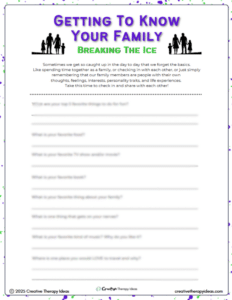
This activity includes prompts that are:
- Low-risk and lighthearted
- Fun to consider
- Easy to answer
- Structured for equal participation
It allows each member to share in a contained, predictable way — which increases safety while giving you early insight into communication styles, comfort levels, and relational tone.
How it Works:
To facilitate this ice breaker activity, you will want to use lighthearted questions that allow family members to get comfortable with sharing about themselves with you and with one another.
This family therapy activity builds trust through the use of questions like:
- “What is your favorite book?”
- “What is your favorite thing about your family?”
- “What are your top 5 favorite things to do for fun?”
Using a worksheet like the one included in my Family Therapy Activity Packet provides an easy way for them to answer their questions and share those answers during session.
You can also turn this activity into a “Who Knows Best?” type of game where each family member takes a turn in the hot seat and everyone tries to guess their answers to the questions. I share more details about this variation in this video about family therapy activities for joining.

💡Therapist Tip:
Another way to get more out of this joining activity is to use circular questioning during by asking questions like:
- “Who in the family would agree the most with that?”
- “Who might see that differently?”
- “Is that the way you thought your son was going to answer that question?”
Processing questions like these can deepen relational awareness without putting anyone on the spot.
2. All About Me Family Bonding Activity
A Structured Joining + Assessment Tool
Once basic rapport is established, you can gently move into more exploratory questions for sharing in family sessions.
The All About Me Worksheet (included in the Family Therapy Activity Packet) offers a simple tool for helping your family therapy clients start to get comfortable sharing more depth in your sessions. This can provide useful assessment info and start to help your clients learn how to communicate with you and one another.
The All About Me worksheet helps you gather insight into:
- Personal strengths
- Worries and stressors
- Individual goals for family therapy
- Family values
- Perceived roles within the system
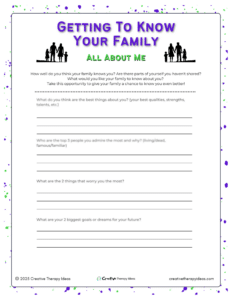
This worksheet serves two important purposes:
✔ It helps each member feel seen as an individual
✔ It gives you rich systemic information early on
Because each person completes their own version, you can compare responses to identify:
- Alignment vs. discrepancy in goals
- Emotional roles
- Misunderstandings and how they handle conflict
- Unspoken expectations
How it Works:
To construct this “All About Me Family Bonding Activity” in your own work, you will want to pose questions that tap into each family member’s individual perspectives. You can ask questions like:
- What are the 2 things that worry you the most?
- What are your 2 biggest goals or dreams for your future?
Using a worksheet like the one included in my Family Therapy Activity Packet offers you a simple way to support each family member in defining their responses and then sharing this more personal information with their family during sessions.
💡Therapist Tip:
During this question and answer activity, you can deepen the work and get more assessment information through circular questioning here as well. You may ask family members to expound on their answers by asking questions like:
- “Who do you think worries the most in your family?”
- “If your sibling answered this question for you, what do you think they would say?”
- “Now that you’ve shared your answer, what do you think your Dad is thinking?”
This approach can draw family members out further while still holding a supportive space for sharing.
3. Cultural Identity Exploration Activity
Exploring Context, Race, Culture, and Systems
Families do not exist in a vacuum and for many families, the many facets of their cultural identities play a big role in how they form and maintain family relationships.
Cultural background, racial identity, socioeconomic status, community influences, and systemic barriers all shape family functioning.
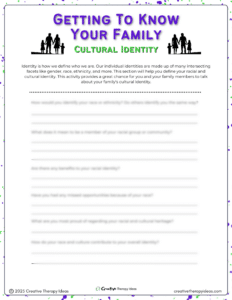
The Cultural Identity Exploration Worksheet (included in the Family Therapy Activity Packet) helps explore:
- Cultural values and traditions
- Experiences with discrimination or marginalization or privilege
- Immigration or generational narratives
- Community influences
- Family traditions, norms, and values
- Extended family expectations
- Religious or spiritual frameworks
This activity supports:
- Cultural humility and cultural competence
- Identity formation and family unity
- Contextualized case conceptualization
- Reduced pathologizing
- Stronger therapeutic alliance
How it Works:
Through thoughtful prompts and questions about culture and ecosystem, you can help families define their cultural identity and clarify their contextual experiences. This is not only helpful for joining and assessment, but it’s helpful for family bonding and unification as well.
You can ask questions like:
- What does it mean to be a member of your racial group or community?
- How do your race and culture contribute to your overall identity?
Using a worksheet like the one included in my Family Therapy Activity Packet can help support productive and emotionally safe conversations about race, ethnicity, gender, generational patterns, and more, even when these things can be challenging, emotional, or painful to discuss.
💡Therapist Tip:
It’s not always easy to talk about race, ethnicity, gender or other aspects of culture in family therapy, but it’s absolutely crucial. It’s a good idea to regularly participate in training to nurture your cultural awareness and strive to be a culturally humble clinician.
When families feel that their lived experiences are acknowledged and respected, this can have a major impact on the joining and assessment process.
How to Build Trust While Managing the Family’s “Defense System”
Early on in treatment, families often show you how they manage vulnerability. Some family members open up with ease, while others put their guard up. Family roles might be suppressed in some family systems, while in others they may intensify.
Some families struggle with vulnerability and deal with their discomfort through humor, while others play the blame game.
Whatever their particular brand of defense system, families teach you a lot about how they operate in those first few sessions. In the face of the challenge to sit with one another in session and look at their “stuff”, families may respond in a variety of ways.
Your job is to observe it, name it, and normalize the struggle. And then communicate both explicitly and implicitly that you will hold the space for them to do this hard work.
Your job is to observe it, name it, and normalize the struggle. And then communicate both explicitly and implicitly that you will hold the space for them to do this hard work.
Holding the Space for the Family Work
You can accomplish this through upholding principles like the following:
✔ Maintain Role Clarity
Be warm — but clear. You are facilitating the process, not joining sides. An observer, a facilitator, and a support. You won’t give them advice or be their friend. You won’t rescue them, or push them too hard, either. It’s your job to give them feedback and offer proposed suggestions. And you will hold the structure of the space, the sessions, and the work. They will do the work itself.
✔ Design Session Activities with Intention
Cooperative activities promote connection, guessing-style prompts can affirm relational connection or reveal relational perception gaps. Deep open-ended questions can cause anxiety, or offer opportunities to ” see what happens if”. Use each style of joining and assessment activity strategically based on the family’s conflict level and coping skills.
✔ Incorporate Structure without Rigidity
Families often respond better to clear structure, session plans, and experiential activities. Predictability lowers threat so the more you can replicate an environmental structure they can count on from session to session, the more comfortable they will feel to step into the work.
✔ Normalize Differences
Highlight patterns neutrally and avoid framing discrepancies as “problems.” Families may operate in a blame-fueled system and normalizing conflict and alternative perspectives can be a helpful way to increase safety in communication.

Want the Family Therapy Activity Packet?
Want to make your life easier and use these three family therapy activities right away?
All of the worksheets mentioned above – including:
- Breaking the Ice Worksheet
- All About Me Family Bonding Worksheet
- Cultural Identity Exploration Worksheet
— are all included in my Family Therapy Activity Packet inside the Creative Therapy Ideas shop.
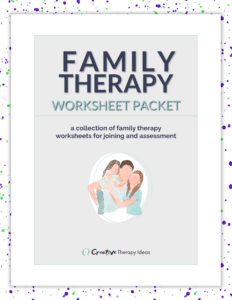
This printable packet is designed to help you:
✔ Build trust in early on in sessions
✔ Increase engagement with hesitant families
✔ Promote family bonding
✔ Facilitate structured assessment
✔ Support culturally responsive family therapy
It’s especially helpful for:
- Family therapists
- Community mental health clinicians
- School-based therapists
- Interns and pre-licensed clinicians
- Therapists working with high-conflict families
👉 You can download the Family Therapy Activity Packet here:
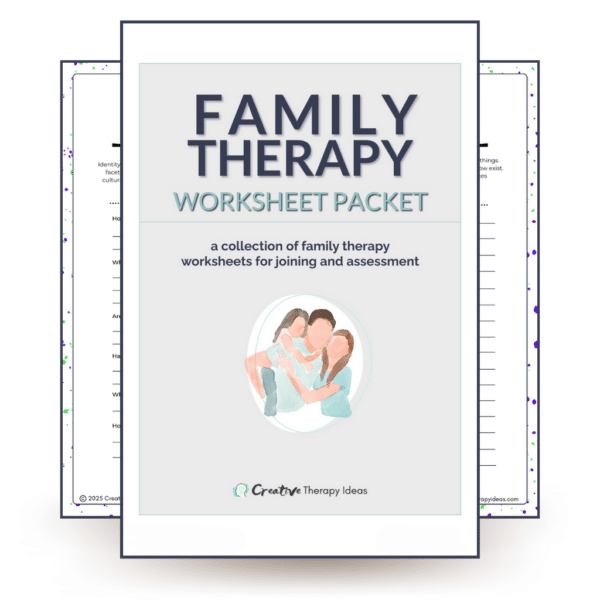
Family Therapy Activity Packet for Joining: 4-page PDF
This family therapy worksheet bundle offers 4 pages of joining and assessment questions – perfect for family therapists looking for joining and assessment activities during family sessions in family therapy. This packet also works well for art therapists, counselors, parents, and all creative mental health pros who work with kids!
Download it instantly and use in your next session!
Early sessions don’t have to feel awkward, chaotic, or surface-level. With the right structure, you can build trust and gather meaningful assessment data — at the same time.
If you run family sessions, which joining activity has worked best for you?